
 by
by 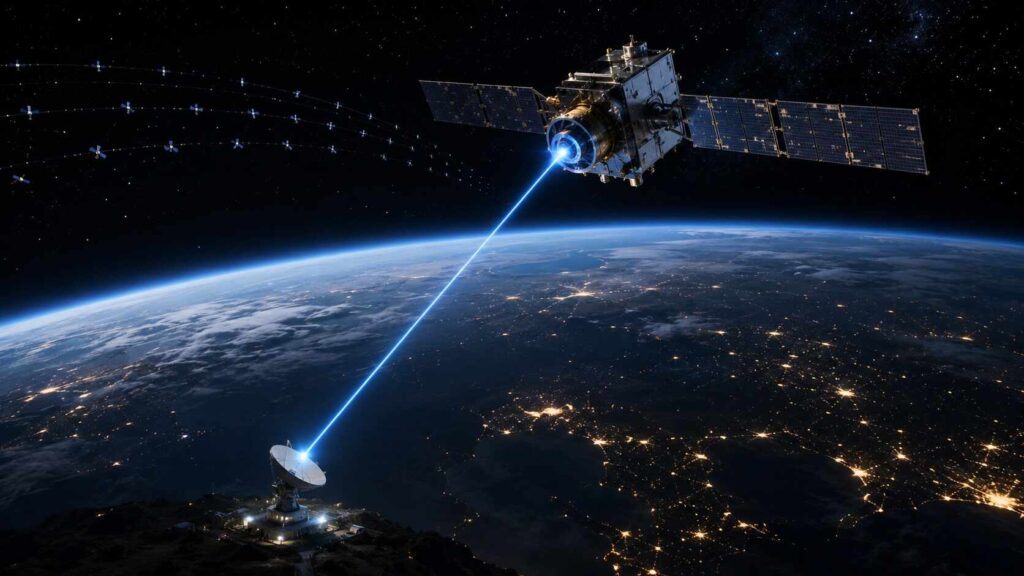
2-watt laser satellite communication is the Chinese laser-downlink breakthrough that reportedly delivered 1Gbps from geostationary orbit, challenging Starlink speed headlines while proving how efficient optical links can move serious data from space.
The test has pushed the phrase “chinese satellite pulverizes starlink” across tech media and search results. That wording is aggressive, but the technical achievement behind it is real enough to deserve attention.
China’s reported system used a 2-watt laser to send data from roughly 36,000km above Earth. That is a far tougher path than a low Earth orbit link, where satellites operate much closer to users and signals travel a shorter distance.
The headline is not just about speed. It is about efficiency. A low-power laser signal survived a long atmospheric path and still delivered a claimed gigabit-class downlink.
That is why 2-watt laser satellite communication matters. It shows that future satellite systems may not need brute-force power if the receiving system is smart enough to recover damaged signals.
The core technology appears to rely on adaptive optics and mode diversity reception. Adaptive optics corrects distortion caused by atmospheric turbulence. Mode diversity reception helps collect usable signal patterns instead of depending on one clean beam.
In simple terms, the system does not wait for perfect conditions. It uses advanced optics to pull data out of a signal that has been bent, blurred and weakened before reaching the ground.
That makes the chinese satellite starlink laser comparison interesting, but it needs context. Starlink is a deployed broadband network with thousands of satellites, consumer terminals and low-latency service. China’s test is a high-orbit optical downlink demonstration with a different mission profile.
| Category | Chinese laser test | Starlink comparison |
|---|---|---|
| Reported speed | Around 1Gbps | Varies by network and use case |
| Orbit type | Geostationary orbit | Low Earth orbit |
| Distance to Earth | About 36,000km | Much closer to users |
| Main advantage | Efficient long-range laser downlink | Scale, latency and coverage |
| Likely use | Remote sensing, secure data, space infrastructure | Consumer and enterprise internet |
This is where the “chinese satellite pulverizes starlink” claim becomes too simple. The Chinese test may beat certain speed headlines under specific conditions, but it does not replace Starlink’s commercial network.
The better takeaway is that laser communication is becoming a serious competitor to traditional radio-frequency satellite links. Optical systems can offer higher bandwidth, tighter beams and less spectrum congestion, especially for satellites that generate huge amounts of data.
The 2026 update strengthens that point. China has also reported much faster satellite-to-ground laser work, including a separate 120Gbps test using AIRSAT-02. That suggests the country is moving beyond one-off demonstrations and toward practical high-capacity optical networks.
For US readers tracking satellite internet speed, Starlink alternatives and next-generation space internet technology, this is the part to watch. The immediate impact is unlikely to be faster home internet. The bigger impact could be faster delivery of satellite imagery, defense data, climate monitoring files and disaster-response mapping.
Still, laser links have limits. Clouds can block them. Weather can weaken them. Ground stations must be placed carefully, and backup radio links may still be required when optical conditions fail.
That is why 2-watt laser satellite communication should be viewed as a major engineering signal, not a finished consumer product. It proves that smarter receivers and precision optics can change the economics of moving data from orbit.
The power figure is especially important. In satellite design, every watt affects payload size, thermal control, battery life and mission cost. A system that performs well with only 2 watts could help future satellites become lighter, more efficient and more capable.
So, did “chinese satellite pulverizes starlink” become a fair headline? Only in a narrow benchmark sense. Starlink still leads in deployed broadband scale. China’s achievement is different: it shows how high-orbit laser downlinks can deliver impressive speed with very low power.
The firm conclusion is this: 2-watt laser satellite communication is not hype, but it is also not a Starlink killer yet. It is a sign that the next space-data race will be fought through laser networks, smarter ground stations and reliable performance under real atmospheric conditions.
If China can scale this technology beyond controlled tests, 2-watt laser satellite communication could become a defining step in the future of high-speed satellite data transfer.
