
 by
by 
The latest breakthroughs in quantum computing 2024 were not consumer-ready machines; they were proof points in error correction, scaling, and quantum-safe security. By 2026, Google Willow, IBM’s roadmap, and post-quantum cryptography define the real story: quantum computing is advancing, but useful commercial deployment still demands better logical qubits, stronger verification, and disciplined risk planning now for serious technology teams today.
- Why 2024 Still Matters in 2026
- Google Willow: The Breakthrough With Substance
- IBM’s Scaling Strategy: Less Hype, More Systems Thinking
- Stanford Twisted Light: A 2026 Signal Worth Watching
- Breakthrough Maturity Scorecard
- The Practical Cybersecurity Breakthrough
- What Is Still Not Ready?
- What Should Readers Do in 2026?
- Final Verdict
- FAQs
Why 2024 Still Matters in 2026
Searchers asking about the latest breakthroughs in quantum computing 2024 want a straight answer: which advances survived the hype?
2024 proved progress in reliability, not mass-market usefulness. The strongest breakthroughs reduced uncertainty around error correction, hardware scaling, and security migration.
That matters for executives, developers, and security teams. A faster benchmark does not solve a business problem. A lower error rate moves the field toward trusted calculations.
Google Willow: The Breakthrough With Substance
Google’s Willow chip became the leading 2024 milestone because it addressed the field’s hardest barrier: errors. Quantum bits are fragile. Noise, heat, and interference can destroy their state before calculation finishes.
Willow’s importance was not only its 105-qubit design. The stronger signal was below-threshold quantum error correction, where adding more qubits helped reduce certain logical errors instead of increasing instability.
That is a serious technical step. It does not mean a company can buy a Willow-style machine and solve drug discovery next quarter. It means one obstacle on the path to fault-tolerant quantum computing looks less impossible.
IBM’s Scaling Strategy: Less Hype, More Systems Thinking
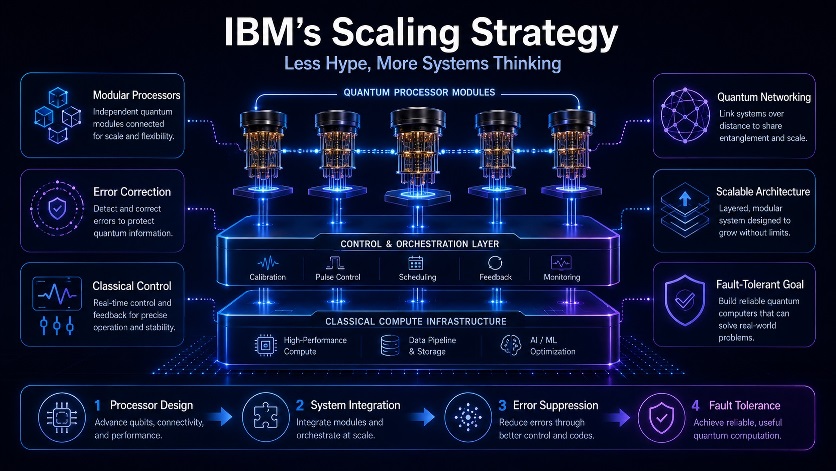
IBM’s 2026 direction is useful because it treats quantum computing as an engineering stack, not a single chip race. Their strategic blueprint prioritizes interconnected hardware modules, advanced error mitigation, and resilient system architectures.
Real quantum advantage needs more than lab demonstrations. Hardware, software, classical control, cooling, networking, and error correction must work as one system.
The lesson is firm: do not judge the market by qubit count alone. Judge vendors by logical qubits, error rates, roadmaps, developer access, and credible use-case testing.
Stanford Twisted Light: A 2026 Signal Worth Watching
The Stanford twisted-light breakthrough adds a different angle. Instead of chasing only bigger cryogenic machines, it points toward smaller quantum components that may operate at room temperature.
The work uses twisted light to connect photon and electron spin states. Once matured, these findings could underpin advanced quantum networking, high-precision detection systems, and significantly more affordable hardware.
It is early-stage. Treat it as direction, not a product. The value is reducing the cost and complexity that keep quantum systems inside specialized labs.
Breakthrough Maturity Scorecard
| Breakthrough | What It Really Shows | 2026 User Takeaway |
|---|---|---|
| Google Willow | Better error-correction behavior as systems scale | Research milestone, not business-ready computing |
| IBM roadmap | Quantum needs modular, fault-tolerant architecture | Watch execution, not only announcements |
| Stanford twisted light | Room-temperature quantum signaling is possible | Promising component research, not a product |
| NIST PQC standards | Quantum-safe migration has started | Security teams should act now |
| Quantum benchmarks | Specialized tasks can show speedups | Ask whether the task has real-world value |
Also Read:
The Practical Cybersecurity Breakthrough
The most actionable outcome from the latest breakthroughs in quantum computing 2024 is cybersecurity planning. NIST finalized post-quantum cryptography standards in 2024, giving organizations a real migration path.
This is not panic. It is asset protection. Sensitive data stolen today may remain valuable for years, creating harvest-now, decrypt-later risk.
Security teams should inventory public-key cryptography, identify long-life data, speak with vendors, and test hybrid migration options. Waiting for a cryptographically relevant quantum computer would be poor governance.
What Is Still Not Ready?
Quantum computing is not ready to replace classical computing. It is not ready for everyday business workloads. It is not ready to break modern encryption at scale.
Most commercial claims need review. Ask three questions before trusting any breakthrough claim: Was it peer-reviewed? Was the benchmark useful? Can the result be independently verified?
This context is exactly what most mainstream reports covering the latest breakthroughs in quantum computing 2024 miss: they list raw headlines without calculating operational value. They list headlines but do not separate lab progress from operational value.
What Should Readers Do in 2026?
Business leaders should monitor quantum without overbuying. Fund small experiments only where chemistry, materials, logistics, or optimization teams have a clear research case.
Developers should learn quantum basics and hybrid workflows. The near future will likely combine classical systems with specialized quantum routines.
Cybersecurity leaders should move faster. Build a post-quantum migration plan, prioritize high-value systems, and document vendor readiness. This is the clearest near-term action.
Final Verdict
The latest breakthroughs in quantum computing 2024 were real, but their meaning has been overstated by weak coverage. Willow strengthened the case for scalable error correction. IBM made the engineering roadmap clearer.
Stanford’s twisted-light work expanded the hardware conversation. NIST gave security teams a practical deadline.
The 2026 reality is direct: quantum computing is becoming measurable, but not routine. The winners will be readers who separate evidence from promotion and prepare before the market becomes obvious.
FAQs
What was the biggest verified hardware quantum computing breakthrough in 2024?
Google Willow, because it showed meaningful progress in quantum error correction.
Is quantum computing useful for businesses in 2026?
Mostly for research, testing, and planning. Broad commercial use remains limited.
Can quantum computers break encryption today?
No public evidence shows current quantum computers breaking modern encryption at scale.
Why does post-quantum cryptography matter now?
Long-life sensitive data may be stolen now and decrypted later.
Is IBM ahead of Google in quantum computing?
Neither is clearly “ahead.” Google leads in error-correction demonstrations; IBM emphasizes scalable architecture.
