


Cryptocurrency can feel like a private club with its own vocabulary: wallets, keys, gas, tokens, exchanges, and blockchains. The truth is less mysterious. Crypto is a way to record, send, and own digital value using software instead of relying only on banks.
This guide explains what is cryptocurrency, how it works, why people use it, what makes cryptocurrency trading risky, and how beginners in the United States and other countries can learn safely before risking money.
What Is Cryptocurrency?
Cryptocurrency is a digital asset secured by cryptography and recorded on a shared network. Bitcoin is the best-known example, but there are many cryptocurrencies with different purposes.
Some are built for payments. Some support software platforms, financial apps, or identity tools. Stablecoins try to track another asset, often the U.S. dollar. Meme coins may have active communities but little practical use.
Here is the simplest comparison: your bank keeps a private record of your balance. A public blockchain keeps a shared record of crypto ownership. When you send crypto, the network checks the transaction and updates that record.
That does not make every cryptocurrency useful or safe. Many projects fail or exist mainly to attract buyers. Rather than fixating on short-term price speculation, newcomers should focus on a much more critical metric: what foundational problem is this digital asset designed to fix?
How Crypto Works Without the Jargon
Blockchain
A blockchain is a digital ledger. It groups transactions into blocks, links those blocks in order, and makes old records difficult to change without broad network agreement.
Wallets and private keys
A crypto wallet does not store coins like a physical wallet stores cash. It stores private keys, which are secret codes that let you access and move your crypto.
These keys can be kept online in a software app, often called a hot wallet, or offline on a physical hardware device, often called cold storage, for stronger protection. A beginner might use an exchange wallet for convenience, then move larger holdings to a hardware wallet after learning self-custody.
One rule matters more than any brand name: never share your recovery phrase. Anyone who has it can usually take the funds.
Consensus and fees
Consensus is how the network agrees on valid transactions. Bitcoin uses proof of work. Many other networks use proof of stake.
Transactions often include network fees, like Ethereum’s “gas” fees. These can spike when many people use the network at once, similar to surge pricing.
Why People Use Cryptocurrencies

People use cryptocurrencies for different reasons. In the United States, beginners often first meet crypto through exchanges, investing apps, tax forms, or Bitcoin headlines. In other countries, crypto may be used for cross-border payments, digital dollars, online work, or protection against unstable local currency.
Crypto is a tool, not magic money, a guaranteed hedge, or a shortcut to wealth. Its value depends on adoption, security, liquidity, regulation, and real demand.
For example, someone sending money overseas might compare a stablecoin transfer with a bank wire. The crypto route may be faster, but the user must understand wallet addresses, fees, exchange rates, and local rules.
Cryptocurrency Trading: What Beginners Should Know
Cryptocurrency trading means buying and selling crypto assets to make a profit. It can be exciting, but it is also where many beginners make expensive mistakes.
Crypto markets trade around the clock. Prices can move sharply because of regulatory news, exchange listings, security breaches, social media, or broader market fear. Once a token is viral all over social media, the initial investors are often already cashing out.
Before trading, decide your risk limit in plain numbers. “I can afford to lose $100 while learning” is safer than “I will see what happens.” Avoid leverage as a beginner; liquidation can wipe out a position even if your market idea is partly right.
Keep records of every buy, sell, swap, transfer, reward, and fee. If you cannot explain why you entered a trade, when you would exit, and what would prove you wrong, you are probably reacting, not trading.
Safety, Scams, Taxes, and Regulation
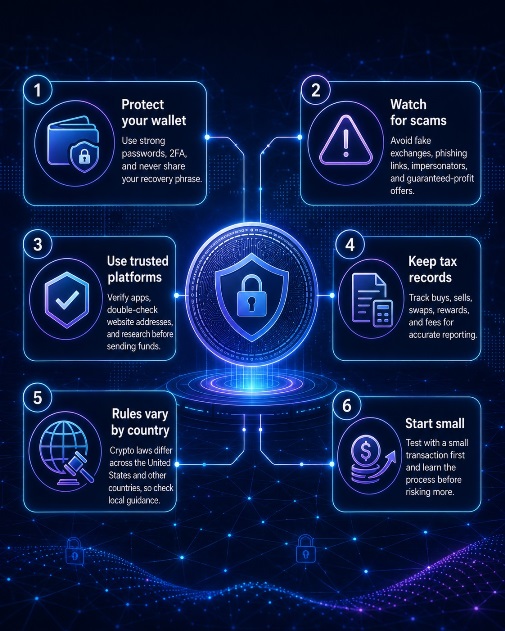
Crypto safety is not only about picking the “best coin.” It is about avoiding irreversible mistakes.
Common scams include fake exchanges, romance-investment schemes, impersonator support agents, phishing links, wallet-draining approvals, fake airdrops, and groups promising guaranteed returns. Real support teams do not need your seed phrase.
Taxes also deserve attention. In the United States, selling crypto, swapping one cryptocurrency for another, receiving crypto as income, or earning rewards may create reporting obligations. Other countries treat cryptocurrencies differently.
Regulation is still developing. Some crypto assets may fall under securities, commodities, tax, payments, anti-money-laundering, or sanctions rules depending on how they are issued and used. For beginners, use reputable platforms, keep records, avoid anonymous offers, and do not assume “decentralized” means risk-free.
How to Start Learning Crypto the Smart Way
Do not start by memorizing hundreds of coin names. Start with the foundations: Bitcoin, Ethereum, wallets, exchanges, stablecoins, fees, scams, and basic tax treatment.
Then try small, low-risk practice. Read a transaction on a block explorer. If you ever send funds, test with a tiny amount first.
The goal is to understand enough cryptocurrency concepts to avoid being rushed, confused, or manipulated.
Conclusion
Cryptocurrency is easier to understand when you treat it as a system, not a lottery ticket. Learn how blockchains record ownership, how wallets protect keys, why fees change, how scams work, and what tax or legal duties may apply in your country.
Before buying or trading, read a beginner guide on crypto wallets or cryptocurrency trading risk management. A calm first step is worth more than a rushed mistake.
FAQ About Cryptocurrency
What is cryptocurrency in simple terms?
Cryptocurrency is digital money or a digital asset recorded on a blockchain. It can be sent online, usually without a bank approving each individual transaction.
Is cryptocurrency trading safe for beginners?
It can be risky. Beginners should avoid leverage, use reputable platforms, start small, protect wallet recovery phrases, and never trust anyone promising guaranteed profits.
What is the safest way to store crypto?
Small amounts may be kept on a reputable platform for convenience. Larger long-term holdings are often safer in self-custody using a well-secured hardware wallet, if the user understands recovery phrases.
